
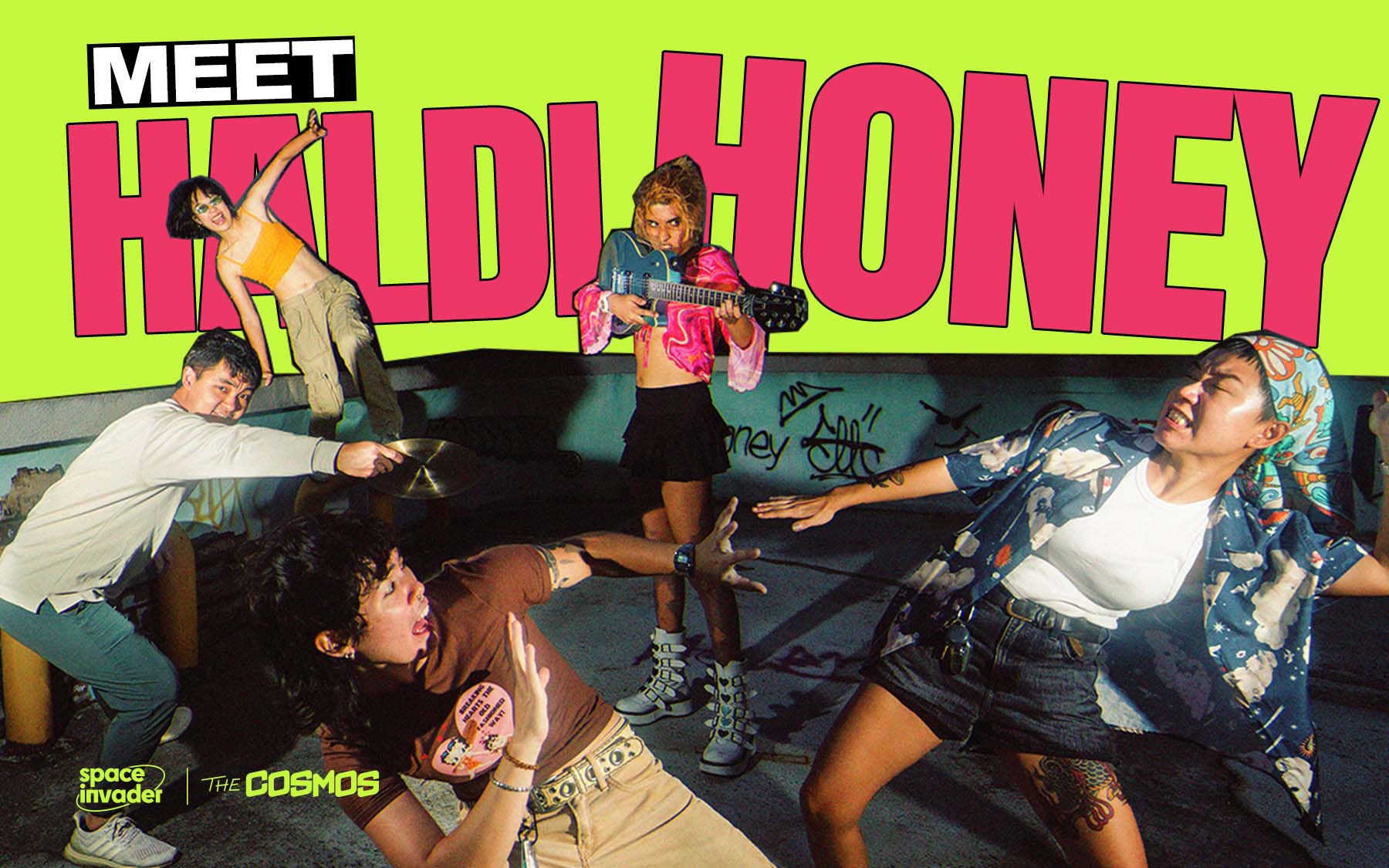
In Singapore’s music scene, which is often seen as small and limited in terms of space and opportunity, those very constraints have become a driving force. Artists push themselves harder, determined to shape their own sound and carry it beyond the island. Haldi Honey is one of the bands that slowly grew out of that environment. They started by experimenting, searching for their own voice, building an audience little by little, until they eventually stepped onto the stage at Baybeats Singapore 2025, the country’s national music festival. Not as a lucky newcomer who happened to be picked, but as a band that had proven that creative energy from the DIY scene can rise up and stand confidently on a major stage.
They describe themselves as a math-pop band, but what’s more compelling than the label is their refusal to stay boxed in. Their music blends intricate rhythms with melodies that are catchy, bright, and genuinely fun. At the same time, their queerness is not treated as a marketing tag. It’s a safe space they’ve built into the core of the band, one that allows everyone to communicate and express their feelings openly, without being confined by gender. From the raw, high-energy spirit of the “boink!” EP to the carefully self-produced album “bask”.
The COSMOS team had the chance to speak with Haldi Honey over email about their music, their worldview, and their perspective on Singapore’s music scene for this edition of Space Invader.
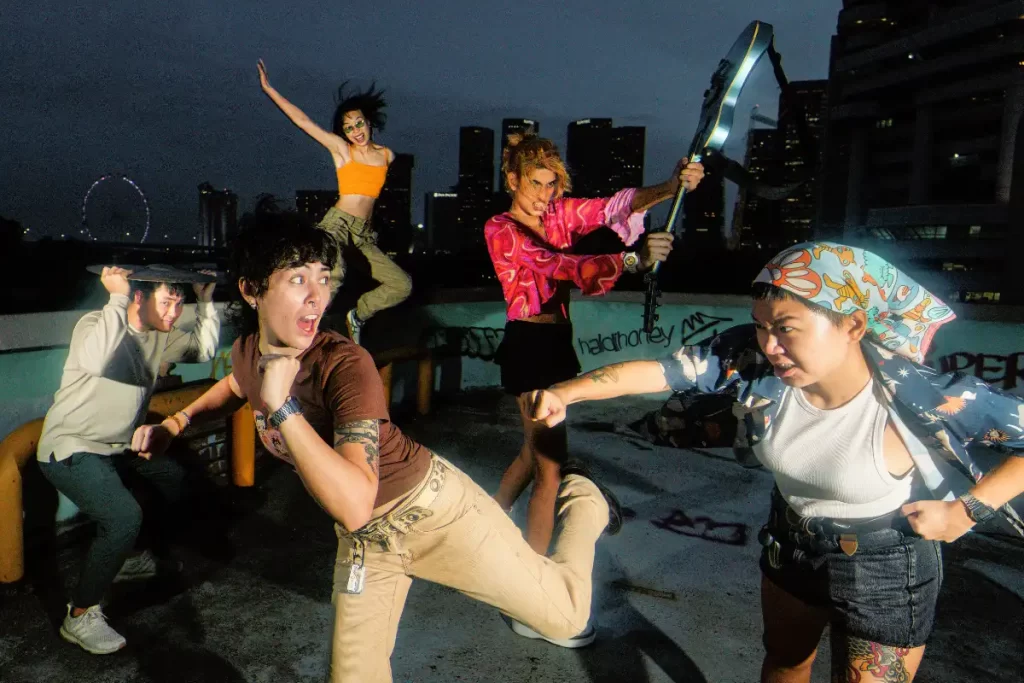
Haldi Honey members:
Daxa
Jade Lee
Anne Lee
Codie Loh
Tay Jin Rong
You performed at Baybeats Singapore 2025, how significant was that experience for you personally, or for a Singaporean artist?
Daxa: Although I’m not Singaporean yet on paper it is one of my life’s missions to make that a reality. I grew up here and the festival is almost as old as I am. So playing it was a dream come true in a very literal sense – when I close my eyes and imagine playing somewhere it’s often with the view of Marina Bay in the background.
Jade: The moment I picked up the guitar seriously was the same moment Daxa asked me to join Haldi Honey and give being in a band a try, almost 4 years ago. Having the opportunity to play at a festival like Baybeats was such a rush. It really showed me how incredible my bandmates are, and how much I’ve flourished just by being surrounded by so many music-loving nerds.
Anne: So many of my favourite local bands/ artists have played at Baybeats or had their start in the Baybeats budding bands program. It feels amazing to follow in their footsteps.
Codie: It’s a milestone for sure. I’ve grown up hearing about Baybeats, seeing the bands I look up to play at Baybeats. It still blows my mind that our band’s name is on the same poster as Ali T.T
What inspired you to get into music, especially growing up in Singapore, where the music scene isn’t always seen as the most prominent?
Daxa: This is something that frustrated me a lot when I was younger. But the music itself is there, the creativity is there, the people are there, however few of us it may be. It’s our job to nurture what we have. The actual problems with the scene aren’t the scene’s fault necessarily – they are structural, and that has knock-on effects.
Codie: I just wanted to do what my favourite artists did for me – making me feel heard and seen. Even though the scene’s tough in Singapore, it’s just a by-product of what Singapore needs to be. And the fact that there’s still so much music being made in spite of that, makes it even more inspiring to keep making music.
What was the first show or moment when you realised this isn’t just a side project anymore?
Daxa: When I released the boink! EP in 2018 – that was the first music project that I made where I was the center of attention, my own personal voice was the priority, and I wasn’t collaborating to further other people’s creative output. I love doing that also, but it made me realise how important it was for me to have a project where my voice is centered. That being said I never thought the music would ever actually go anywhere or be listened to and loved by anyone until we played Baybeats itself 😀 and my bandmates (especially JR—Tay Jin Rong) are the ones who convinced me our music was worth working hard for.
Codie: When I decided to actually buy a bass and learn how to play it instead of always borrowing Daxa’s HAHA.
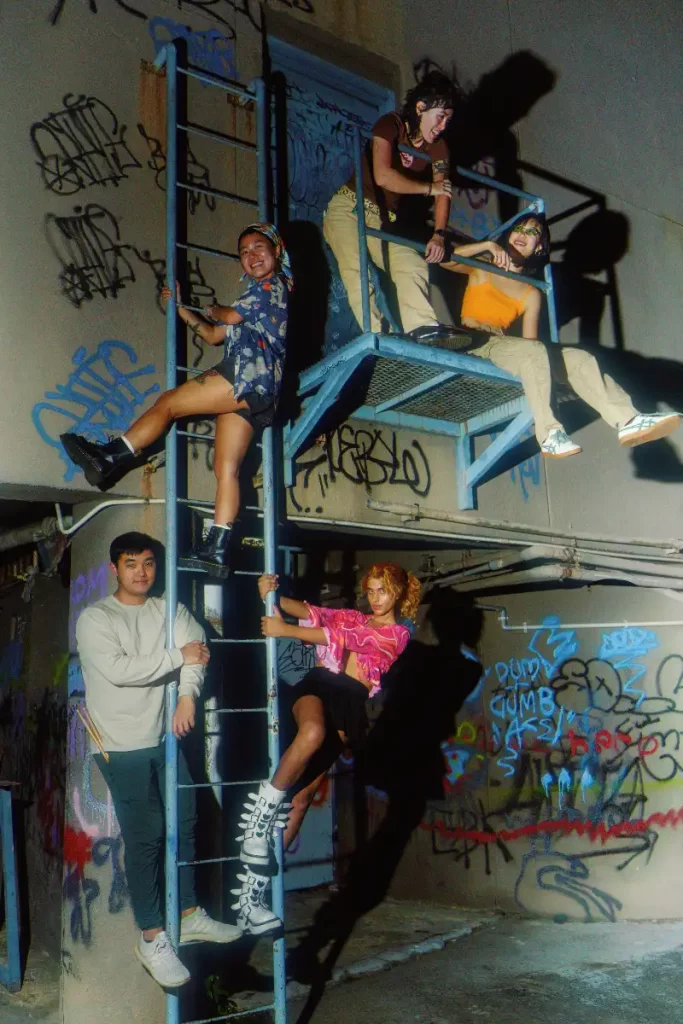
So how did the band come together?
Codie: Daxa, Jade, Anne and I met on Tinder. Though the 3 of their fates were intertwined beforehand HAHA. And as we realised that we needed a drummer because poor Daxa’s been drumming AND singing for 2 years, we found JR on SOFT (a Singapore-based forum for musicians that still looks like it’s stuck in the 2000s).
You’ve described your sound as math-pop. How do you strike that balance between rhythmic trickiness and pop accessibility?
Daxa: This is actually a very technical question. It is possible to hide odd time signatures and tempo changes with careful and interesting beat stresses, calculations of relative tempos with subdivisions in other tempos, etc. But most importantly, if the audience doesn’t know how to dance to my weird groove, it means I’m not dancing enough on stage to show them!
How has your sound or creative process evolved from the Boink! EP to bask?
Daxa: boink! is reflective of the place I was in physically at the time, and had a lot of collaborators involved, my friends Will Kwiatkowski and Marcus Dembinski played drums, and I had David Fuller re-amp the guitars, and I borrowed an 8 string from his friend. The processes were more analog, and I didn’t know how a synth really worked yet. I still loved pop music, but its influence was more in the songwriting than the production. I also made a lot of internet and gaming references. I go outside more now. bask was made alone, in a bedroom, like so many of the best pop albums these days are. I doubled down on layering my own vocals on top of each other, and experimented a lot with electronic textures and catchy hooks. I can imagine a music video for every single one of those songs – but for boink! I imagine an underground basement show 😀
Many songs on bask feel deeply personal yet playful. How do you decide which parts of your lives to turn into lyrics?
Daxa: When I write music, it sort of explodes out of me like vomit. But so far I’ve written all the lyrics – and there’s two types of songs. One where I write all the music first, and then think about what feelings caused me to vomit out those sounds. Then I sort of sit down and carefully write poetry around it. The other kind is when the lyrics are part of the vomit – it all came out all at once, and even if I think of a better line later, I can’t bring myself to change it because the song reflects my intense feelings of the time. Everything I write about, even the silly stuff, is the most important thing to me at that point in my life. Lately, we’ve been writing songs together, and it is a new and fun challenge to write lyrics to stuff that wasn’t vomited out – music that was created as a conversation instead. But the topics are mostly the same.
You self-produced, mixed and mastered much of the album. What was the hardest or proudest technical moment in that process?
Daxa: Getting my vocals to have that pop “airiness” with my cheap microphone and my newly changed voice that I wasn’t fully used to yet… that took ages and I thought I would never manage! What’s the point of making math pop if you still sound like a rock singer and not a pop diva.
Which song from this album best represents who Haldi Honey are as a band, one that you’d recommend as the first track for someone who’s never heard your music before?
Jade: We recently made a video asking each member about their favourite song of ours, and boy boy came out on top both on and off stage! Of the pop songs on bask, it’s definitely the one with the mathiest groove buried underneath.
Singapore’s a cultural crossroads. How does being based there affect your creative instincts?
Daxa: Sort of indirectly. Because the people and places and things I love are multicultural and often uniquely Singaporean, I guess the references and vibe reflects that of life here a bit. But, it’s still all in English and largely in a western genre. I don’t really go out of my way to incorporate Singaporeanness. Maybe because I was homesick, the previous EP boink actually has a bit more references to home, since I made it when I was in the US.
You’ve been open about being a queer band. What kind of change do you think you can bring to Singapore’s music scene, or what do you hope to see happen in it?
Daxa: Gay people have always been great artists, great tastemakers, and more importantly, good at playing instruments. I’m a little sick of the “female-fronted” label. I’m interested in seeing female and queer-backed bands as well. Queer kids kind of disproportionately gravitate towards art making for self expression, so I don’t feel like they need our help to be “inspired”. But I do also want straight audiences to come out and enjoy queer art more. Just like our genre, I feel like there’s no reason it has to be niche. It can be mainstream, if you open your mind a tiny bit. Straight people could learn a thing or two from lesbians about how to really feel your feelings.
How does queerness shape your creative chemistry as a group? Does it affect how you communicate, write, or trust one another?
Codie: I think being queer or a queer ally heightens our sensitivity. And that comes through when we communicate not just about music but also as friends. Like how supportive we are of each other, how we check in on each other to make sure we’re all okay. Even when disputes happen, we still talk to each other with respect and from a place of vulnerability instead of defensiveness.
Daxa: There is also a lot to be said for the comfort that comes with not having to explain yourself, and when you’re making art, you have to be vulnerable. Having to walk on eggshells or justify and explain basic aspects of your humanness to your collaborators would pretty quickly put a pin in any sort of creativity that you can achieve together. It is nice to be seen and understood in a deeper more innate way.
Are there particular queer artists, local or global, who’ve inspired how you see yourselves or what’s possible for your music?
Daxa: Blair Benzel from good game, some of her music is just the peak of human achievement in my favourite genre of all time. the “get good” album makes me cry every single time. Yvette Young sort of spearheaded mainstream visibility and acceptance of queer music in niche genres – she broke through to Reddit music-heads in a compelling way. Chappell Roan for broad cultural acceptance of insane lesbian feelings (I have seen full rooms of 30-50 something straight men blasting her music screaming and dancing along). Rosalía is so so creative and boundary pushing in the pop genre, but also proudly bares her queerness in her accompanying visuals and styling.
Singapore’s creative scene still wrestles with censorship and conservatism. How do you find room for joy and resistance within that environment?
Codie: There’s always gonna be people or institutions that don’t agree with what you stand for. It’s a lost cause trying to defeat it, and I’d rather give my time and effort to give energy to the people and communities that I care about.
We are not familiar with Singapore’s music scene at all. From your perspective, how would you describe the current state of the scene there?
Daxa: the music scene was always really interesting and colourful, but it definitely exploded after the first round of covid-19 lockdowns. there were a lot of really creative people cooped up at home with nothing better to do than learn new instruments and produce music. i do wish we didn’t suffer from the same ailments as most DIY scenes around the world – venues and studios shut down sometimes more often than they can be replaced. most of our memories are made in places that don’t really exist anymore. but despite this, there is a strong vibe of everyone really supporting each other and having each other’s back. maybe it’s an artefact of how small this island is, and how unique our vibe and sound can be. it feels worth protecting and showing up for, and so most people do.
What’s the biggest challenge of being an artist in Singapore?
Anne: Choosing between not having enough time or not having enough money 😭
What’s the next step for Haldi Honey?
Codie: Writing an album together! And touring hehehe. And also spend more time doing shenanigans together.
What advice would you give to younger queer musicians who are just starting out and wondering if it’s safe to be themselves?
Anne: This is advice I’d give to any young musician (queer or not) – try to find friends and find community. It’s the best feeling to realise there are people like you, who are passionate about the same things you care about. Join music groups at school, go to gigs, try to put yourself out there and show up for others! There is strength in numbers. Meeting other musicians, including other queer musicians, has given me a lot of courage to be myself and express myself through music.
If you could leave a feeling with someone who just discovered you through bask, what would it be?
Daxa: I love this question so much. I used to always say that I wanted my music to feel like hugging a pikachu. warm and soft and full of love but your hair will be standing up from the electric shock.
Follow Haldi Honey on Instagram, X, Bandcamp and Youtube.
ชอบไปคอนเสิร์ตเพราะเป็นกิจกรรมที่ทำคนเดียวได้ และยังชอบแนะนำวงดนตรีใหม่ ๆ ผ่านตัวอักษรตลอดเวลา